

The Baltic Crusade 1100 – 1500
The Baltic Crusades were a series of military campaigns initiated by the Catholic Church, primarily led by the Teutonic Knights, the Livonian Brothers of the Sword, and other Christian military orders. These campaigns occurred from the 12th to 15th centuries with the goal of converting pagan Baltic tribes to Christianity and incorporating their territories into the Christian world.
The context for these Northern Crusades was the broader medieval Crusades, which aimed to reclaim Christian territories and spread the faith. Unlike the more famous Crusades targeting the Holy Land, the Baltic Crusades were directed toward north-eastern Europe, including present-day Estonia, Latvia, Lithuania, and parts of Russia. These regions were inhabited by pagan tribes like the Old Prussians, Livonians, and Lithuanians.
The initial stages of the Northern Crusades involved Christian merchants and missionaries venturing into the Baltic territories, encountering resistance that led to military intervention. The Livonian Brothers of the Sword played a significant role initially, but after a major defeat, they merged with the Teutonic Knights, who then intensified their crusading efforts. This eventually led to the establishment of the Monastic State of the Teutonic Knights.
The campaigns were marked by both military conquests and alliances. While some tribes were forcibly converted, others adopted Christianity to secure alliances. For instance, Lithuania resisted the Teutonic Knights for centuries, but adopted Christianity in the late 14th century to counter the Teutonic threat by forming a union with Poland.
By the 15th century, the power of the Teutonic Knights began to decline, culminating in their defeat at the Battle of Grunwald in 1410. The Wendish Crusade in the mid-12th century focused on the pagan Wends of the southern Baltic Sea coast, revealing the complex interplay of religious, political, and territorial ambitions in the region.
The Prussian Crusade of the 13th century targeted the Old Prussians, a pagan Baltic tribe, and was led by the Teutonic Knights. Despite initial resistance, the Knights gradually gained control over the region, reshaping its religious, political, and cultural landscape.
Overall, the Baltic Crusades left a lasting impact on the Baltic region, leading to the spread of Christianity and the establishment of new political and cultural dynamics.
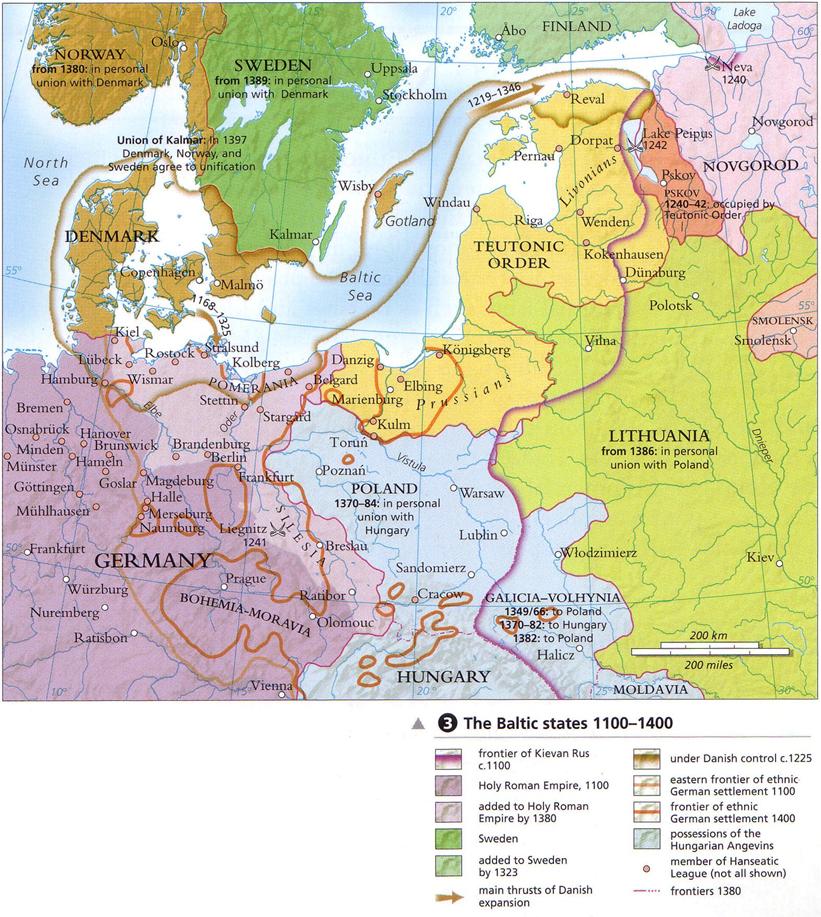
Baltic States 1100-1400 CE
image: www.worldhistory.org
(click on the images to enlarge)

A woodcut of Latvia’s capital Riga, dating from a 1575 French edition of Sebastian Münster’s encyclopedic work,
the Cosmographia Universalis.
image: Wikimedia